

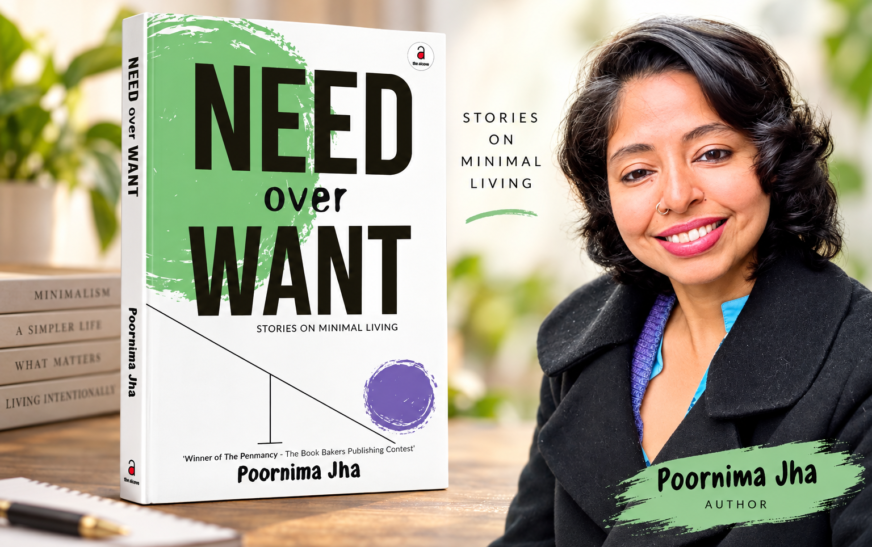
Poornima Jha’s book uses stories of work, relationships, money and everyday consumption to examine an old question made urgent by modern life: how much is enough?
There is a peculiar contradiction at the heart of contemporary living. Convenience has multiplied, possessions have become easier to acquire and the vocabulary of aspiration has expanded. Yet, for many, so have clutter, distraction and the persistent feeling that there is never quite enough — enough money, enough time, enough achievement or enough life.
Poornima Jha’s Need Over Want: Stories on Minimal Living begins from within this contradiction.
Published by The Alcove Publishers, the book is built around a deceptively uncomplicated proposition: before acquiring more, perhaps it is worth asking what is actually necessary. But Jha is careful not to turn minimalism into an argument for deprivation. Early in the book, she dismisses the caricature of the minimalist as someone inhabiting an empty house or renouncing ordinary comforts. Her argument is instead about priorities — retaining what contributes meaningfully to one’s life and reconsidering what merely occupies space, money, attention or time.
Minimalism Beyond Decluttering
This distinction gives Need Over Want its wider canvas.
The book moves from the consequences of a maximal lifestyle to the home, the workplace, fitness, relationships, financial freedom, stress, travel and, finally, the practical challenges of sustaining a minimalist life.
That structure matters because Jha’s idea of excess is not confined to an overflowing wardrobe.
A life may be cluttered by objects, but it may equally be cluttered by commitments, expectations, unhealthy relationships, digital distractions or the pressure to keep pace with somebody else’s definition of success. The recurring question is therefore not simply, What can I throw away? It is closer to: What deserves a place in my life?
That is also where the title acquires its significance. “Need” and “want” are not presented merely as categories of personal finance. They become a way of examining choices.
Stories Make the Argument
Jha originally considered writing a conventional work of non-fiction. Instead, she chose fiction as the route into the subject. It is one of the book’s more distinctive decisions.
In the opening chapter, Saraswati and Lakshmi occupy sharply contrasting worlds. Saraswati, a teacher in Nagapattinam, finds purpose in service and independence; Lakshmi seeks consolation in possessions and is distressed over a diamond necklace she expects for her wedding. Yet Jha avoids making the contrast entirely superficial. Beneath Lakshmi’s anger about the necklace lies something less material — a daughter’s longing for her father’s attention. Her maximal lifestyle becomes, in part, an attempt to fill an emotional absence.
It is an effective illustration of one of the book’s better observations: consumption is not always about greed. Sometimes what appears to be a desire for an object is a substitute for something that cannot be purchased.
Elsewhere, Kalyani’s story pushes the idea of “letting go” into considerably more difficult territory. Emerging from an abusive marriage, she begins disposing of possessions associated with that period of her life. A necklace ceases to be jewellery and becomes a reminder of confinement. Gradually, decluttering extends from objects to relationships and emotional burdens.
Here, minimalism is less an aesthetic than an act of reclaiming agency.
The Real Cost of ‘More’
Jha is at her most persuasive when she asks the reader to calculate cost beyond the price printed on a label.
An object requires money to buy, but it may also require space to store, effort to maintain and time to use. The book repeatedly returns to this less visible economy of possession.
The same logic is extended to consumer habits. Advertising, sales, social-media comparison and the fear of missing out are examined as forces capable of turning desire into something resembling necessity.
Yet the book does not suggest that comfort, good clothes, travel or expensive experiences are inherently suspect. One of its characters, for instance, argues for spending on experiences while deliberately cutting expenditure elsewhere. The point is not austerity for its own sake; it is deciding what deserves one’s resources.
This makes Need Over Want less doctrinaire than its subject might suggest. It does not prescribe a magic number of possessions or demand that everyone live identically. Its more useful proposition is that “enough” is personal — but it should be consciously determined rather than externally dictated.
From Fiction to a Practical Workbook
The fictional episodes are accompanied by questions, exercises and practical observations. Readers are encouraged to examine recurring purchases, impulsive shopping, duplicates at home and the influence of trends and advertising. Other sections consider why one might pursue minimalism — financial stability, time, self-care, environmental concerns, relationships or simply the desire for a less distracted life.
This gives the book a hybrid character: part storytelling, part lifestyle reflection and part workbook.
It also prevents minimalism from remaining an attractive abstraction. The reader is repeatedly required to bring the argument back to his or her own cupboard, bank statement, calendar, workplace and relationships.
Poornima Jha: Engineering Precision Meets Lifestyle Writing

There is an interesting distance between Jha’s professional world and the subject of her book.
Based in Germany, she works as a Functional Safety and Cybersecurity Manager in the construction machinery industry, after close to two decades in global automotive and construction engineering environments. Outside that career, running and writing have remained important parts of her life. She writes on mindful living, fitness, travel and lifestyle choices through her blog, Laws of Positive Lifestyle.
Need Over Want grew organically out of approximately six years of blogging and her research into minimalism. Jha’s experience as a working mother also gives the idea of prioritisation a practical dimension. In her own life, she attempts to apply minimalism not merely to possessions, but to career, commitments, relationships, hobbies, family, health and the expectations one places upon oneself.
That background perhaps explains why the book is interested less in immaculate minimalist interiors than in the allocation of finite resources: time, attention, energy and money.
A Wider Release for a Wider Conversation
The Alcove Publishers is now preparing Need Over Want for a wider international release, encouraged by the universality of its subject and the practical nature of its message.
Minimalism is no longer merely a niche lifestyle conversation. Its questions have acquired greater relevance in a world of accelerated consumption, habitual upgrading, shrinking attention spans and increasingly short relationships with the objects people buy and discard.
The question at the centre of Jha’s book travels easily across borders: How much of what modern life urges us to acquire, pursue and retain do we actually need?
The Alcove sees scope for wider distribution precisely because the book attempts to make minimalism workable rather than merely aspirational. Its stories lead into exercises and everyday applications; its concerns extend from shopping and possessions to work, money, relationships, fitness, leisure and time.
In a fast-paced, fast-spending and increasingly throwaway world, the publisher’s attempt to take the book to a wider readership is also an attempt to bring the conversation around minimalism into everyday life — not by asking people to reject comfort or ambition, but by asking them to examine both more deliberately.
A Book About ‘Enough’
At its centre, Need Over Want is not really asking readers to own less.
It is asking them to define enough.
That difference is important.
A society built around consumption inevitably encourages the next purchase; a competitive culture supplies the next milestone; social media provides the next person against whom life can be measured. Jha’s response is neither withdrawal nor rejection of ambition. It is an argument for choosing ambition more carefully.
The book repeatedly brings attention back to the things, goals and people that are essential, and to the freedom that can come from reducing what distracts from them.
For a book about minimalism, Need Over Want ultimately has surprisingly little to do with empty spaces. Its concern is with what remains after the unnecessary has been removed.
And that may be the more difficult question of all: once the noise of wanting is reduced, do we know what we actually need?