
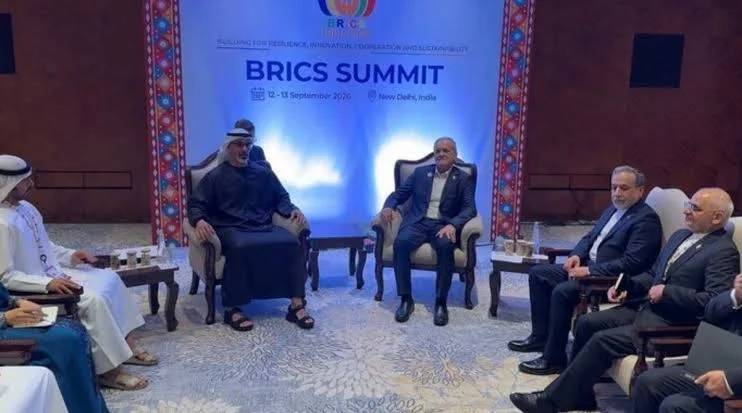
The meeting between Iranian President Masoud Pezeshkian and Abu Dhabi Crown Prince Sheikh Khaled bin Mohamed bin Zayed Al Nahyan on the sidelines of the BRICS Summit in New Delhi has emerged as one of the most significant diplomatic moments of the gathering. It was the highest-level public meeting between Iran and the UAE since the outbreak of the West Asia war.
The timing is particularly important. Relations between Tehran and Abu Dhabi have come under severe strain during the conflict, with the UAE suspending trade and financial dealings with Iran and warning that rebuilding trust would depend on actions rather than promises. The two countries have also been caught on opposite sides of a conflict that has increasingly threatened Gulf security and regional trade.
Yet the New Delhi meeting suggests that diplomacy has not completely disappeared. The discussions focused on regional and international issues, de-escalation, stability and prospects for peace and development. Neither side announced a major breakthrough, making it premature to describe the encounter as a full diplomatic thaw.
Its larger significance lies in the role of BRICS as a diplomatic meeting ground. Iran and the UAE were able to participate in a joint declaration calling for restraint, protection of civilians, respect for sovereignty and diplomatic solutions to the regional crisis. Achieving consensus among countries with sharply different positions was itself a diplomatic achievement.
For India, the episode strengthens the argument that its BRICS presidency can provide diplomatic space without formally positioning New Delhi as a mediator. India’s approach has been to keep difficult conversations alive while protecting its relationships across competing geopolitical camps.
The Iran-UAE meeting therefore may not immediately change the balance of power in West Asia. But it demonstrates something equally important: even amid war, communication channels can survive. And in an increasingly fragmented global order, creating space for dialogue may itself be a form of diplomacy.