
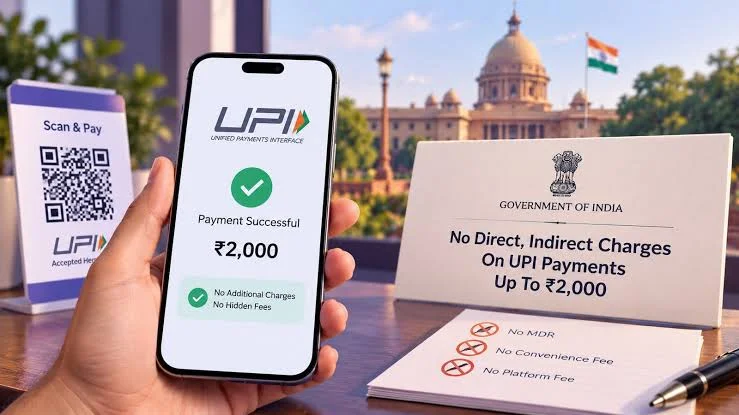
The Centre has formally moved to protect small-value UPI payments from transaction charges, bringing clarity to months of uncertainty over whether India’s most widely used digital payment system could eventually introduce fees. Under a Finance Ministry notification issued on September 14, banks and payment-system providers cannot impose direct or indirect charges on UPI transactions of up to ₹2,000. The same protection applies to RuPay-powered debit card payments.
The move is significant because the government recently amended the legal framework governing digital payments, creating the possibility of introducing a Merchant Discount Rate (MDR) on selected transactions in the future. That amendment did not itself impose a fee, but it opened the door for a charge-based model for some higher-value merchant payments.
For ordinary consumers, the immediate message is reassuring. Payments up to ₹2,000 through UPI remain protected from charges, meaning everyday transactions such as small purchases, food payments and local retail payments can continue without an additional transaction fee. The notification specifically prevents banks and payment providers from charging either the person sending or receiving the payment.
However, the new framework also signals that the economics of UPI could evolve. India’s digital-payment infrastructure requires continuous investment in cybersecurity, fraud prevention, technology and network capacity. The Finance Ministry has argued that a sustainable revenue model may eventually be necessary as transaction volumes continue to expand.
UPI processed 2,366 crore transactions worth ₹29.9 lakh crore in July 2026 alone, demonstrating the enormous scale of the system. It has also expanded internationally, with UPI live in 11 countries.
The bigger question now concerns transactions above ₹2,000. The government has created room for a future charging mechanism, but the latest notification does not mean that users will automatically start paying fees on higher-value UPI transactions. The eventual structure, if introduced, will determine how merchants, banks and payment companies share the cost of maintaining the ecosystem.
For now, the policy draws a clear line: small-value UPI payments remain free, while the future pricing model for larger transactions remains open.