
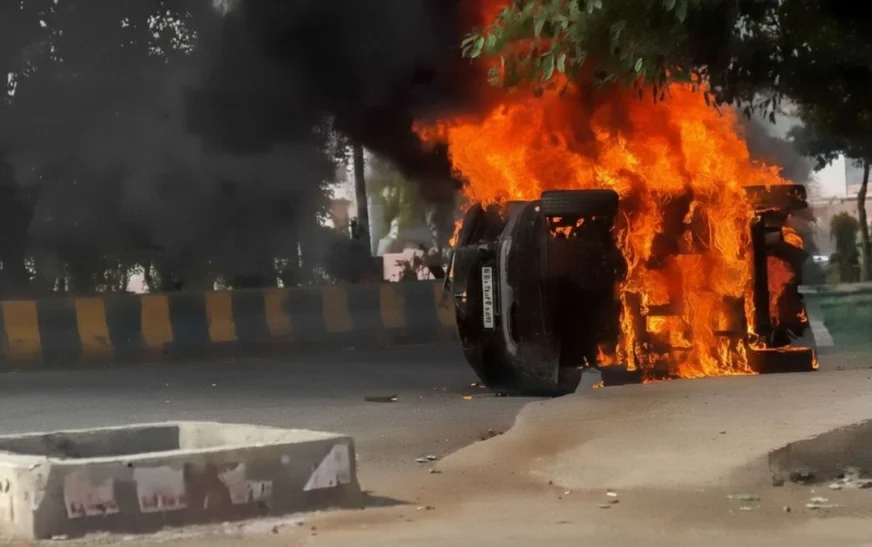
Industrial Hub on Edge as Protests Turn Violent
Noida’s industrial belt witnessed intense unrest as thousands of factory workers took to the streets demanding a minimum monthly wage of ₹20,000, triggering clashes, arson, and large-scale disruption. The protests, which began as a wage agitation, quickly escalated into violence with vehicles torched and police forced to use tear gas to regain control.
The scale of the unrest reflects a deeper frustration among workers who claim that stagnant wages have failed to keep pace with rising living costs.
The Core Demand: ₹20,000 for an 8-Hour Workday
At the heart of the agitation lies a simple yet powerful demand — fair wages. Workers across industrial units argued that current salaries, often ranging between ₹10,000 and ₹13,000, are insufficient to meet basic expenses.
Many workers also highlighted long working hours, with some reporting 12-hour shifts without adequate compensation, further intensifying the discontent.
The demand for ₹20,000 has now become symbolic of a broader push for dignity and economic security.
Haryana Factor and Rising Expectations
The trigger for the Noida protests can be traced to neighbouring Haryana, where a recent 35% hike in minimum wages raised expectations among workers in Uttar Pradesh.
The disparity in wages for similar work across state borders has amplified dissatisfaction, with workers demanding parity and uniform standards.
Government Steps In Amid Escalation
As tensions escalated, the Uttar Pradesh government moved swiftly, initiating late-night talks through a special panel to address worker grievances. Simultaneously, authorities announced interim measures, including revised wage structures and improved labour conditions, in an attempt to restore normalcy.
The administration has also emphasized dialogue, urging both workers and industry stakeholders to resolve issues peacefully.
A Wider Signal for India’s Labour Landscape
The Noida unrest is not an isolated incident. Similar protests in industrial hubs like Manesar point to a growing pattern of labour dissatisfaction driven by inflation, wage stagnation, and changing economic realities.
This episode serves as a reminder that India’s growth story must remain inclusive — balancing industrial expansion with fair compensation and worker welfare.
A Moment for Structural Reform
The events in Noida highlight a critical truth — economic growth cannot be sustained without addressing grassroots realities.
The ₹20,000 demand is not merely a number; it represents a call for dignity, fairness, and recognition.
As negotiations continue, the challenge before policymakers is clear:
to transform unrest into reform,
and ensure that development is not just rapid — but equitable.