
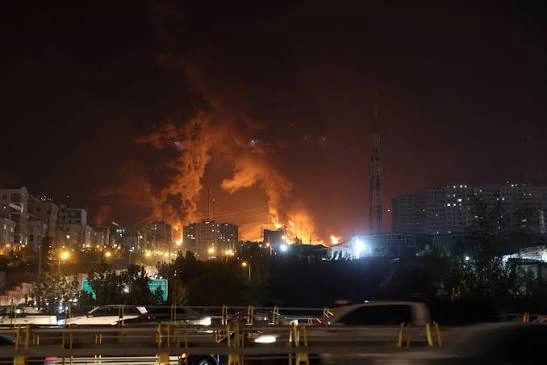
The conflict in West Asia intensified on July 30, 2026, after the United States military launched a new wave of precision airstrikes across Iran, targeting military infrastructure linked to the Islamic Revolutionary Guard Corps (IRGC). The operation came hours after Iran allegedly launched ballistic missiles at a U.S. military installation in Jordan, an attack that Washington said was successfully intercepted.
The latest military action marks another significant escalation in the ongoing Iran conflict, raising concerns of a broader regional war involving multiple countries across the Middle East.
US Targets Multiple Military Installations
According to the U.S. Central Command (CENTCOM), the two-hour operation struck dozens of military targets across Iran. The targets reportedly included:
- IRGC command and control centres
- Missile launch facilities
- Drone production and storage sites
- Coastal defence systems
- Surveillance installations
- Maritime military assets
U.S. officials described the strikes as a direct response to Iran’s missile attack and stated that the objective was to degrade Iran’s military capabilities while protecting American personnel stationed in the region.
Iranian Missile Attack Triggered Retaliation
The fresh strikes followed what U.S. officials described as a surprise ballistic missile attack launched by Iran against American forces based in Jordan. According to Washington, the missiles were intercepted before causing casualties or significant damage.
President Donald Trump vowed a strong response, stating that attacks on U.S. forces would not go unanswered. The subsequent military operation represented one of the largest American strikes against Iranian military infrastructure in recent weeks.
Jordan Intercepts Missiles
Jordan confirmed that its air defence systems intercepted five Iranian missiles that entered its airspace. Authorities said the missiles were destroyed before reaching populated areas, and no casualties were reported.
The incident highlights the growing risk faced by neighbouring countries as the conflict expands beyond Iran and Israel, affecting regional security and airspace across the Middle East.
Regional Conflict Continues to Expand
The renewed fighting comes after a brief pause in U.S. military operations that had been intended to create space for diplomatic negotiations.
However, the latest exchange of missile attacks and airstrikes indicates that diplomatic efforts have failed to reduce tensions. Recent developments have also included coordinated operations by the United States and Saudi Arabia against Iran-backed militias in Iraq, further widening the conflict.
Concerns Over Global Energy Security
The continued military escalation has renewed concerns about the security of the Strait of Hormuz, one of the world’s most important oil shipping routes.
Although commercial shipping has continued in parts of the Gulf, analysts warn that prolonged hostilities could disrupt global energy supplies and increase volatility in international oil markets. Governments across the region remain on high alert as military operations continue.
International Community Calls for Restraint
Several countries and international organisations have urged both Washington and Tehran to avoid further escalation and return to diplomatic negotiations. However, with military operations continuing and retaliatory threats remaining, prospects for an immediate de-escalation appear uncertain.
Security analysts warn that any additional attacks involving U.S. allies or Gulf nations could broaden the conflict even further, increasing humanitarian and economic risks across the region.
Situation Remains Highly Volatile
The latest U.S. airstrikes demonstrate the rapidly evolving nature of the conflict in West Asia. While Washington maintains that its operations are defensive and aimed at protecting American forces, Iran has continued to condemn the strikes and has signalled that it reserves the right to respond.
As military activity intensifies and diplomatic efforts struggle to gain momentum, the international community is closely monitoring developments, with fears that the conflict could expand into a wider regional confrontation if both sides continue to exchange attacks.