
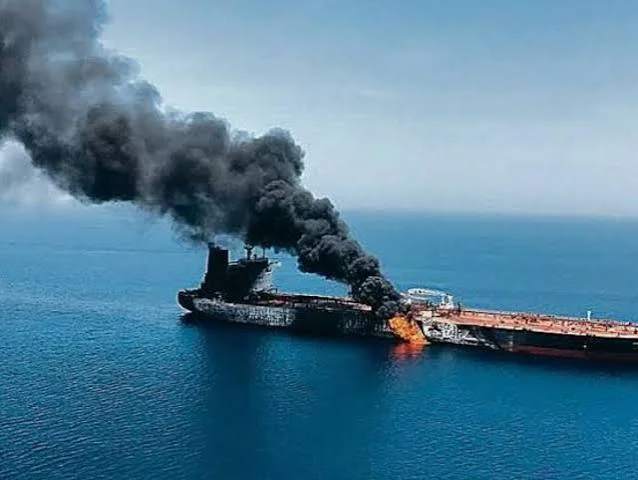
The incident involving the Panama-flagged oil tanker El Gaia has triggered a fresh confrontation between Iran and the United States over the security of shipping in the Strait of Hormuz. Iran’s Islamic Revolutionary Guard Corps (IRGC) says the tanker caught fire after striking naval mines, while US Central Command (CENTCOM) has rejected that account as false and accused Iranian forces of attacking the vessel.
According to the IRGC version reported by Iranian state media, El Gaia entered what Tehran described as a restricted route south of the Strait and subsequently hit naval mines. The vessel reportedly caught fire, with Iran maintaining that ships must follow its security instructions while transiting the waterway.
Washington has offered a completely different explanation. CENTCOM says El Gaia was struck by an Iranian missile last month and rendered inoperable before being attacked again by an Iranian drone over the weekend while it was off the coast of Oman. The US military says the tanker is now being towed by a regional partner.
The conflicting accounts have emerged amid an increasingly dangerous environment for commercial vessels. Reuters reported that the International Maritime Organization confirmed El Gaia had been damaged and that two seafarers were missing, although it did not establish how the damage occurred. Thirteen of the vessel’s 14 Indian crew members were subsequently reported rescued.
The significance extends beyond one tanker. The Strait of Hormuz remains a crucial energy corridor, and vessel traffic has fallen sharply amid the conflict. Any perception that ships could face mines, missiles or drones while using the waterway could further discourage commercial operators and increase insurance and freight costs.
For global energy markets, the dispute is therefore another warning sign. Whether the El Gaia incident ultimately proves to be a mine strike or an Iranian missile-and-drone attack, the immediate reality is the same: commercial shipping through one of the world’s most important oil routes remains dangerously uncertain.