
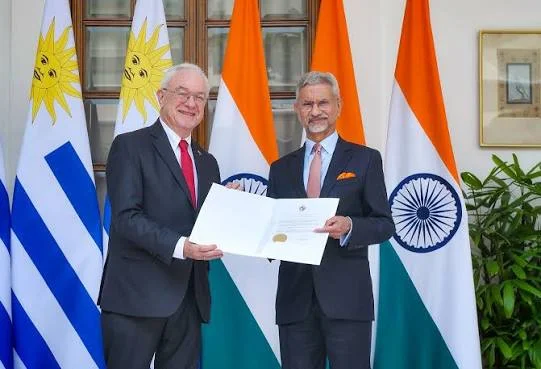
Uruguay’s Foreign Minister Mario Lubetkin has described India’s 2026 BRICS chairship as a major diplomatic success, arguing that the results of the New Delhi Summit demonstrate the growing influence of India in the Global South. His assessment comes after BRICS members adopted the New Delhi Declaration despite significant differences over ongoing wars, geopolitical tensions and the future of the international order.
Lubetkin said the ability of Prime Minister Narendra Modi and the Indian government to facilitate consensus among countries with sharply different interests was more important than political rhetoric. He described the declaration as concrete and substantive, pointing to the agreement reached on sensitive international issues as evidence of India’s diplomatic role.
The assessment is significant because BRICS itself has become increasingly diverse. Its expanded membership includes major powers with competing strategic interests, making consensus considerably harder than when the grouping was smaller. Yet India’s presidency produced more than 50 reported outcomes across areas including resilience, innovation, cooperation and sustainability.
The summit also demonstrated India’s preference for diplomacy that keeps competing countries at the same table. The joint BRICS position on the Middle East, supported by both Iran and the UAE despite their tensions, offered a notable example of dialogue surviving amid conflict.
For India, however, the real measure of success will come after the summit. A declaration can establish consensus, but translating it into trade, financial cooperation, technology partnerships and institutional reform will determine whether the chairship produces lasting influence.
Lubetkin’s comments therefore matter not simply as praise for Modi. They underline a broader shift: countries across the Global South increasingly see India as a power capable of connecting different interests without demanding political alignment.
That may ultimately be the strongest outcome of India’s BRICS presidency—not transforming the bloc overnight, but demonstrating that New Delhi can turn geopolitical diversity into a platform for practical cooperation.