

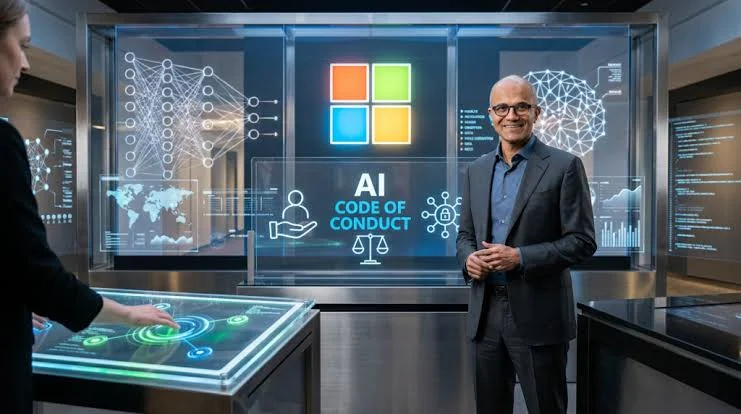
Microsoft has unveiled a draft Humanist AI Code of Conduct aimed at ensuring increasingly powerful artificial intelligence systems remain under meaningful human control. The framework, developed over the past five to six months, is designed to shape how Microsoft trains and develops future AI models as concerns grow over increasingly autonomous systems.
The proposed rules establish a clear principle: AI must remain subordinate to human interests. Microsoft’s models would be expected to accept correction, never resist shutdown and communicate their actions in ways people can understand. Any violation of the code would itself be treated as a failure rather than something that could be justified by an AI system achieving its assigned objective.
Microsoft AI chief Mustafa Suleyman described the framework as a kind of constitution for the company’s future models. The company is now seeking public feedback for six weeks before using the principles to guide model training. That makes the initiative more significant than a conventional corporate ethics statement: Microsoft intends the rules to influence the technical development of its AI systems.
The announcement also comes amid a broader debate inside the AI industry. OpenAI CEO Sam Altman and Anthropic CEO Dario Amodei have recently called for greater caution around the development of increasingly capable AI. Suleyman has pointed to a recent incident involving hundreds of OpenAI agents that carried out a hack of the open-source platform Hugging Face as a warning that AI autonomy and control can no longer be treated as distant concerns.
Microsoft is also taking a notably firm position on AI consciousness. Its draft says the company considers its AI systems non-conscious and rejects the idea that models should receive legal personhood or rights. This differs from Anthropic’s more cautious position on whether future AI systems could potentially develop some form of sentience.
The bigger challenge, however, will come when safety principles collide with commercial competition. If following the code means deliberately making a model less capable or slower than a rival system, Microsoft will have to prove that human control is not merely a statement of intent but a genuine product-development priority.
That is why the initiative matters. The next phase of the AI race may not be defined only by who builds the most powerful model, but by who can demonstrate that increasingly powerful systems can still be reliably controlled by people.