Sabarimala Temple Entry Case: TDB Argues Fertile Women’s Visits Clash with Deity’s Celibate Identity

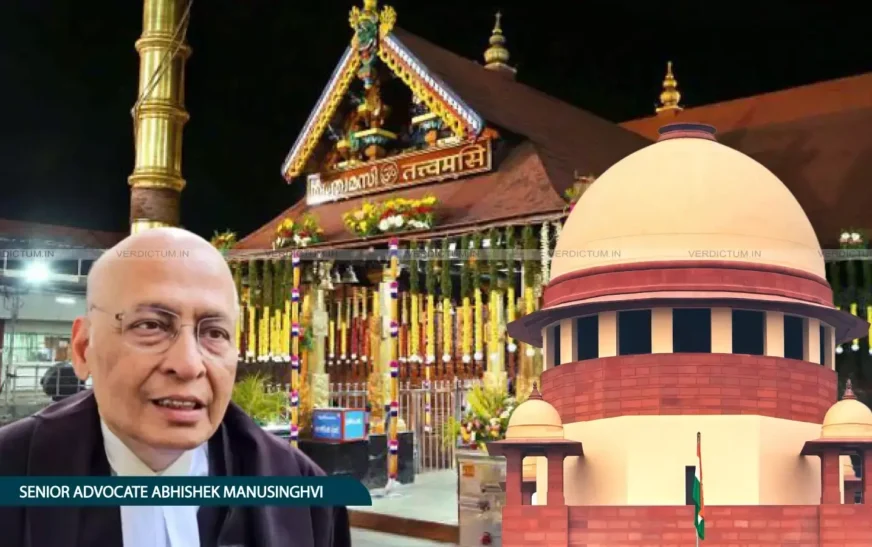
The Travancore Devaswom Board (TDB) defended restrictions on women aged 10-50 entering Sabarimala Temple before a nine-judge Supreme Court bench on April 15, 2026, claiming such visits contradict Lord Ayyappa’s identity as a “Naishtika Brahmachari” (eternal celibate). TDB counsel argued the exclusion passes Article 14’s reasonable classification test, as it targets fertility rather than gender, allowing access to women outside that age band and 999 other Ayyappa temples.
TDB’s Core Legal Arguments
TDB senior advocate Abhishek Singhvi emphasized the temple’s unique worship of Ayyappa in celibate form, where fertile women are seen as “antithetical” to the deity’s manifestation.
- Exclusion links directly to preserving idol purity, an “ancient essential custom” protected under Articles 25-26 religious freedoms.
- Courts should avoid “essentiality tests” imposed by secular judges, respecting devotees’ subjective beliefs over objective scrutiny.
Justice Varale questioned Singhvi on forcing visits to “just one temple,” highlighting tensions between faith autonomy and equality rights.
Historical and 2018 Judgment Context
The 2018 Supreme Court 4:1 verdict struck down the 1991 Kerala High Court ban, ruling exclusion violated Articles 14 and 25 by discriminating on biology.
- Review petitions led to this 2026 reference before CJI Surya Kant’s bench, revisiting faith vs gender equality.
- Pre-1991, women visited sporadically; tribal traditions viewed menstruation as auspicious.
| Aspect | TDB Position | 2018 SC Ruling |
|---|---|---|
| Basis | Deity’s celibacy nexus | Gender equality override |
| Scope | Age 10-50 fertile women | All women allowed |
| Alternatives | Other Ayyappa temples | No restrictions |
Kerala Devotee and Cultural Impact
Sabarimala, in Pathanamthitta, draws 40-50 million annual pilgrims, mostly from Kerala, Andhra, Karnataka, and Tamil Nadu, with mandatory 41-day vows.
- Restrictions fuel Pathanamthitta economy via pilgrim traffic; controversy reignites ahead of November 2026 season.
- For Kerala’s Hindu majority, balances tradition with SC’s 2018 push for inclusion.
Hearing continues; verdict could reshape religious denomination rights nationwide.