
Organisational Reset Signals Strategic Realignment Within NDA
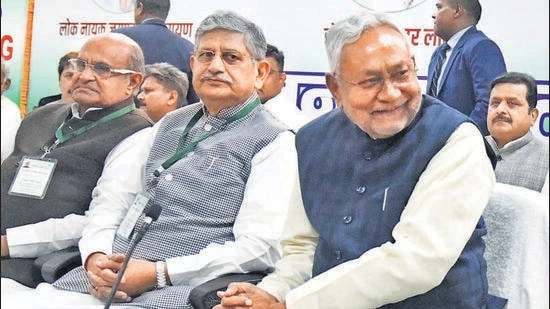
In a significant organisational move, Nitish Kumar has reconstituted the Janata Dal (United) national team, appointing Sanjay Jha as Working President and elevating key leaders, including Chandravanshi as Vice-President. The reshuffle comes at a time when the party is recalibrating its position within the NDA coalition framework.
The restructuring reflects a clear attempt to streamline leadership, reinforce internal control, and prepare for upcoming electoral challenges.
Continuity with Control
The decision to retain Sanjay Jha in a pivotal role signals continuity and trust within the party’s inner circle. At the same time, the broader reshuffle indicates Nitish Kumar’s intent to centralise authority while delegating operational responsibilities to trusted leaders.
Notably, the absence of his son Nishant Kumar from the new structure has drawn attention, reinforcing the message that organisational decisions are currently being kept distinct from any immediate succession narrative.
Shift Towards National Politics
The reconstitution follows Nitish Kumar’s transition from Bihar politics to a national role in the Rajya Sabha, marking a shift in focus from state-level governance to broader political positioning.
This move is widely seen as part of a larger strategy to strengthen JD(U)’s relevance within the NDA, particularly at a time when coalition dynamics remain fluid and leadership clarity is critical.
Coalition Calculus
As a key ally of the BJP within the NDA, JD(U)’s internal restructuring carries wider political implications. A stronger and more organised JD(U) could:
- Reinforce the coalition’s position in Bihar
- Provide stability in alliance negotiations
- Influence seat-sharing and electoral strategies
At the same time, it reflects Nitish Kumar’s effort to retain political leverage within the alliance structure.
A Strategic Reset
The timing of the reshuffle suggests more than routine organisational changes. It signals a strategic reset, aimed at:
- Strengthening the party’s internal machinery
- Reasserting leadership control
- Preparing for future political alignments
Nitish Kumar’s move to reconstitute the JD(U) national team marks a calculated step in repositioning the party within India’s evolving political landscape.
As coalition politics continues to shape electoral outcomes, the effectiveness of this organisational reset will play a crucial role in determining JD(U)’s influence both within Bihar and at the national level.