
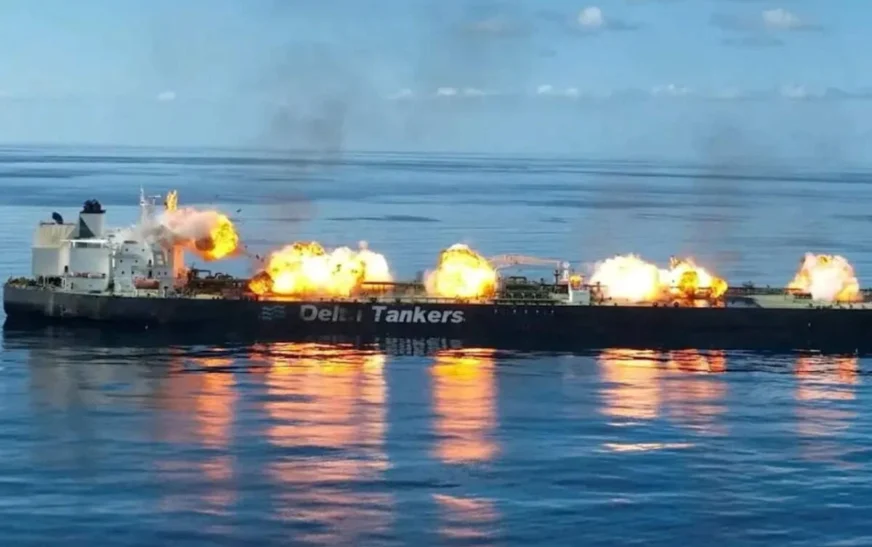
Yemen’s Iran-backed Houthi movement has claimed responsibility for missile and drone attacks on two Saudi oil tankers transiting the Red Sea, marking a significant escalation in the ongoing regional conflict. The strikes have intensified fears of a new maritime chokepoint near the Bab el-Mandeb Strait, a critical global shipping route that connects the Red Sea to the Gulf of Aden.
According to Houthi military spokesperson Yahya Saree, the vessels targeted were the Encelia and Layla. The group said the attacks were part of a newly announced naval blockade against Saudi Arabia and warned that additional vessels linked to Saudi interests could be targeted if regional hostilities continue.
The development comes as the wider conflict involving Iran continues to escalate. While Iran has tightened its control over the Strait of Hormuz, the Houthis’ actions in the Red Sea raise the possibility of simultaneous disruptions at two of the world’s most strategically important energy corridors. Together, the Strait of Hormuz and the Bab el-Mandeb handle a substantial share of global oil and liquefied natural gas shipments.
The Bab el-Mandeb Strait is a vital maritime gateway linking Europe, Asia, and the Middle East through the Suez Canal. Any prolonged disruption in the area could force commercial vessels to reroute around the Cape of Good Hope, increasing transit times, shipping costs, insurance premiums, and fuel expenses for global trade.
The attacks have also prompted renewed concerns among shipping companies and energy markets. Several commercial operators are reportedly reviewing their routes through the Red Sea, while insurers are closely monitoring the evolving security situation. Analysts warn that sustained instability could put upward pressure on global crude oil prices and disrupt supply chains already facing geopolitical uncertainties.
Meanwhile, the United States has continued military operations targeting Iran, carrying out another round of strikes as part of its ongoing campaign against Iranian military capabilities. Washington has also warned that attacks on international shipping and energy infrastructure could trigger further responses against Iran and its regional allies.
International leaders have expressed growing concern over the risk of the conflict spreading beyond its current boundaries. Governments have urged all parties to avoid actions that could threaten freedom of navigation or disrupt international commerce, emphasizing the importance of maintaining secure sea lanes for global trade and energy supplies.
The latest Houthi claims underscore the increasing role of maritime security in the broader Middle East conflict. With tensions remaining high across the region, shipping companies, energy markets, and governments are closely monitoring developments around both the Red Sea and the Strait of Hormuz, where any further escalation could have far-reaching consequences for global trade and economic stability.