
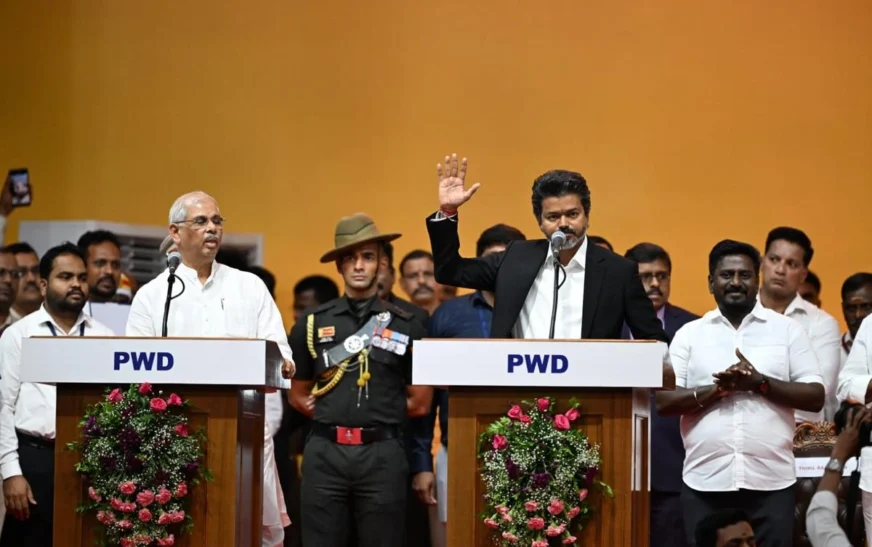
Tamil Nadu has entered a new political era with the swearing‑in of C. Joseph Vijay as Chief Minister, and the full contours of his first‑time cabinet are now clear. Alongside Vijay, nine Tamilaga Vettri Kazhagam (TVK) MLAs took the oath as ministers on May 10, 2026, at the Jawaharlal Nehru Indoor Stadium in Chennai, under the watch of Governor Rajendra Vishwanath Arlekar. The group is a mix of party‑organisers, old‑school strategists, and young‑blood faces, combining N Anand (Bussy Anand), Aadhav Arjuna, K.A. Sengottaiyan, K.G. Arunraj, P. Venkataramanan, R. Nirmalkumar, Rajmohan, T.K. Prabhu, and S. Keerthana.
The key ministers in Vijay’s cabinet
- N. Anand (Bussy Anand) – Party General Secretary and MLA‑elect from Thiyagarayanagar (Chennai), Anand is one of the key organisational brains behind TVK’s rapid rise; his presence in the cabinet signals that internal‑party‑management and election‑war‑room skills will anchor the government’s day‑to‑day operations.
- Aadhav Arjuna – General Secretary for Election Campaign Management and MLA‑elect from Villivakkam (Chennai), Arjuna is the party’s campaign‑tactician, responsible for the street‑level, booth‑level machinery that delivered the 108‑seat sweep; his role will likely straddle media‑management, communication, and political‑orchestration rather than one fixed portfolio.
- K.A. Sengottaiyan – Veteran nine‑time MLA from Tiruvannamalai, former AIADMK heavyweight who joined TVK; Sengottaiyan brings the “old‑Dravidian‑era” experience and the soft‑power needed to stabilise the coalition across rural belts. His inclusion is a signal to the AIADMK‑leaning voters that their representative still has a voice in the new dispensation.
- S. Keerthana – MLA‑elect from Virudhunagar and one of the youngest faces in the cabinet; Keerthana’s elevation gives the government a youthful, gender‑inclusive image and is intended to attract the younger, aspirational electorate that has driven TVK’s social‑media‑based campaign.
How this cabinet structure looks on paper
The rest of the nine‑minister cohort includes:
- K.G. Arunraj – former IRS officer, now Policy and Propaganda General Secretary and MLA‑elect from Tiruchengodu, expected to handle the more technical‑and‑finance‑linked ministries.
- P. Venkataramanan – Party Treasurer and MLA‑elect from Mylapore, likely to anchor the state‑finances and resource‑allocation side of the government.
- R. Nirmalkumar – Joint General Secretary and MLA‑elect from Thirupparankundram, positioned to manage the party’s internal discipline and the Madurai‑Jaffna‑Corridor dynamics.
- Rajmohan – Propaganda Secretary and MLA‑elect from Egmore, set to drive the government’s narrative‑and‑communication‑front, especially in the Tamil media space.
- T.K. Prabhu – Dentist‑turned‑politician and MLA‑elect from Karaikudi, who brings a professional‑middle‑class‑oriented perspective to the cabinet.
What the TVK‑centric cabinet signals
The Vijay‑led cabinet is entirely TVK‑dominated, with the Congress and Left‑VCK alliance providing only external support rather than ministerial seats. This means the first‑time CM will rely heavily on his own party’s cadre‑network and the nine‑minister‑core to run the state, while the Congress‑led MLAs and Left‑VCK will likely influence policy from the backseat, especially in welfare‑and‑social‑justice‑schemes.
The mix of experience‑heavy Sengottaiyan, organisational‑savvy Anand, campaign‑master‑Aadhav Arjuna, and youth‑symbol Keerthana is designed to give the government both stability and a “change‑from‑status‑quo” feel. The next 10 days will be crucial: Vijay must prove his majority on the floor of the Assembly by May 13 and then quickly parcel the 18‑plus major ministries among these nine TVK‑ministers, with the remaining slots going to the Congress‑backed and Left‑VCK‑backed MLAs once the formalisation of support is completed.
In the long run, this cabinet will be judged not by the star‑power of the CM, but by how effectively this nine‑person‑core team translates the TVK‑manifesto—a mix of 200‑unit‑free‑electricity, women‑protection forces, education and industry‑expansion—into a functioning, sustainable administration in a state that has never been ruled by a party‑outside‑the‑Dravidian‑duopoly before.