
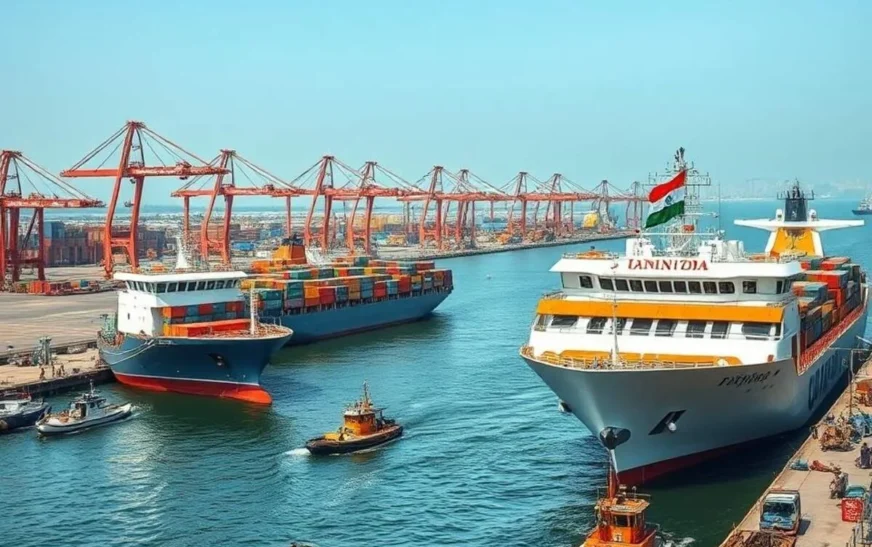
India is planning to add 100 vessels to its merchant shipping fleet over the next five years as the government looks to reduce the country’s dependence on foreign shipping companies and lower its massive foreign freight expenditure. Union Ports, Shipping and Waterways Minister Sarbananda Sonowal announced the plan at the first Sagar Samvad organised by the National Shipping Board in New Delhi.
The scale of the challenge explains why the government is focusing on domestic shipping capacity. According to Minister of State Shantanu Thakur, India currently pays nearly US$75 billion every year to foreign shipping lines for transporting essential commodities such as crude oil, gas, coal and urea. Building a larger Indian-flagged fleet could therefore help retain more of this expenditure within the domestic economy.
From an analytical perspective, the proposed 100-ship expansion is about more than simply increasing the number of vessels. It is part of a broader attempt to make India’s maritime sector more competitive and reduce strategic dependence on overseas shipping companies. For a country that imports large quantities of energy and raw materials while increasingly participating in global trade, shipping capacity is closely linked to economic and national security.
However, India faces a major cost disadvantage. Industry representatives at the event said operating Indian-flagged vessels is currently around 16% to 20% more expensive than operating under foreign flags. Higher taxes, freight costs, domestic financing expenses and regulatory burdens were identified as some of the reasons behind the gap.
This is arguably the biggest challenge facing the government’s plan. Simply ordering or acquiring more ships will not be enough if Indian shipping companies continue to face higher operating costs. The industry needs an environment in which owning and operating an Indian-flagged vessel becomes commercially attractive.
The National Shipping Board has proposed a five-point roadmap covering fiscal reforms, assured cargo support, competitive financing, regulatory simplification and improved ease of doing business. If implemented effectively, these measures could help close the cost gap and encourage private investment in the shipping sector.
The government’s ambitions also extend beyond the next five years. The plan is linked to India’s longer-term objective of becoming one of the world’s top five ship-owning nations by 2047. That means the 100 additional vessels should be viewed as an initial step rather than the final target.
Another important dimension is employment. A larger merchant fleet will require more trained seafarers, engineers and maritime professionals. Labour and Employment Minister Mansukh Mandaviya has stressed the need to expand training and create opportunities for young people, while also addressing the gender gap in the maritime workforce. Emerging areas such as cruise shipping and advanced shipbuilding could create additional employment opportunities.
The strategy therefore connects shipping, manufacturing, employment and economic security. A stronger domestic fleet could support Indian exporters and importers, create demand for shipbuilding and maritime services, and reduce exposure to disruptions in international shipping markets.
The bigger test will be execution. India will need competitive financing, modern shipyards, skilled manpower and predictable regulations to turn the 100-ship target into reality.
If these reforms succeed, the initiative could mark an important shift in India’s maritime economy. The objective is not merely to own more ships, but to build a competitive Indian shipping ecosystem capable of carrying a much larger share of the country’s international trade.