
India has joined the United States and 24 other countries in an international 6G initiative, giving New Delhi a seat at an early-stage effort to shape the security, interoperability and technological architecture of next-generation telecom networks. The announcement followed a meeting between US Commerce Secretary Howard Lutnick and India’s Minister of State for Commerce Jitin Prasada during the G20 Innovation Ministerial.
The initiative is significant because the global battle over 6G will not be limited to faster mobile internet. Future networks are expected to become critical infrastructure for artificial intelligence, autonomous systems, industrial automation, connected devices and strategic communications. The participating countries are focusing on network security, resilience, interoperability and trusted AI.
India’s Strategic Opportunity
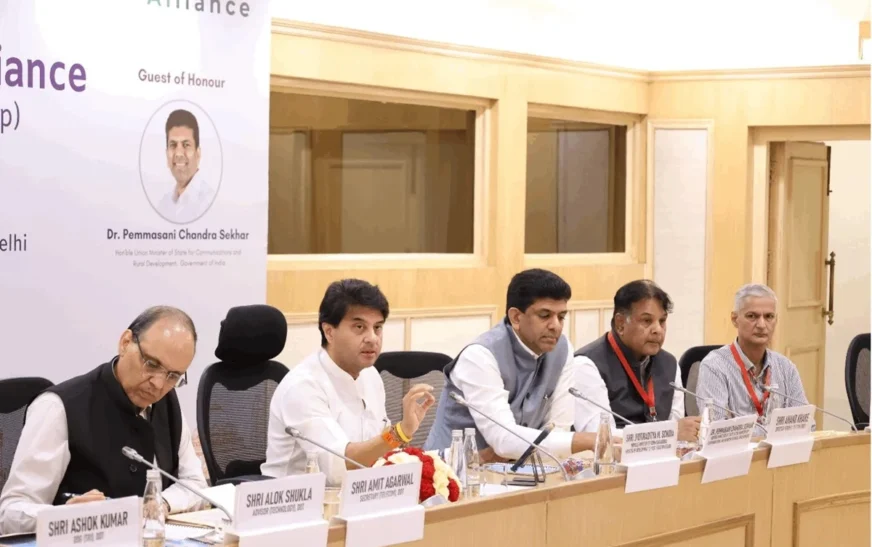
India’s participation also complements its own Bharat 6G Mission, rather than replacing it. The government wants India to become a contributor to 6G intellectual property, products and global standards by 2030. The Bharat 6G Alliance has already grown to 90 members spanning telecom companies, startups, academia and research institutions.
India is also increasing its presence in international standard-setting. Government data shows Indian participation in 3GPP rose from 717 participants in 2020 to 1,787 in 2025, while technical contributions increased sharply during the same period.
Beyond Connectivity
The bigger strategic question is whether India can convert participation into technology ownership. Joining an international framework gives New Delhi influence, but real leadership will depend on patents, indigenous equipment, semiconductor capabilities, testing infrastructure and successful commercial deployment.
For India, therefore, the 6G race is not simply about adopting the next wireless generation. It is about ensuring that when global 6G standards are finalised, Indian technology and Indian requirements are part of the architecture from the beginning.