
Floods are no longer seasonal disasters—they are warnings that demand action.
Every monsoon, Kerala braces for heavy rain. Rivers swell, dams are monitored, roads disappear under water, and landslides once again dominate headlines. Relief camps are opened, rescue teams work tirelessly, and communities come together to help one another.
Yet, when the waters recede, an uncomfortable question remains.
Are these disasters becoming inevitable because of the rain—or because we have failed to act on what we already know?
Kerala is one of India’s most ecologically sensitive states. The Western Ghats, its extensive river network, dense forests and coastal ecosystems make it uniquely beautiful. They also make it vulnerable. Heavy rainfall is not new. What is new is the increasing frequency and severity with which floods, landslides and soil erosion are affecting lives and livelihoods.
Climate change has undoubtedly intensified extreme weather events. However, climate alone does not explain why the impact appears to grow with each passing year.
The Human Factor
Experts have, for years, pointed to several interconnected challenges that continue to increase Kerala’s vulnerability.
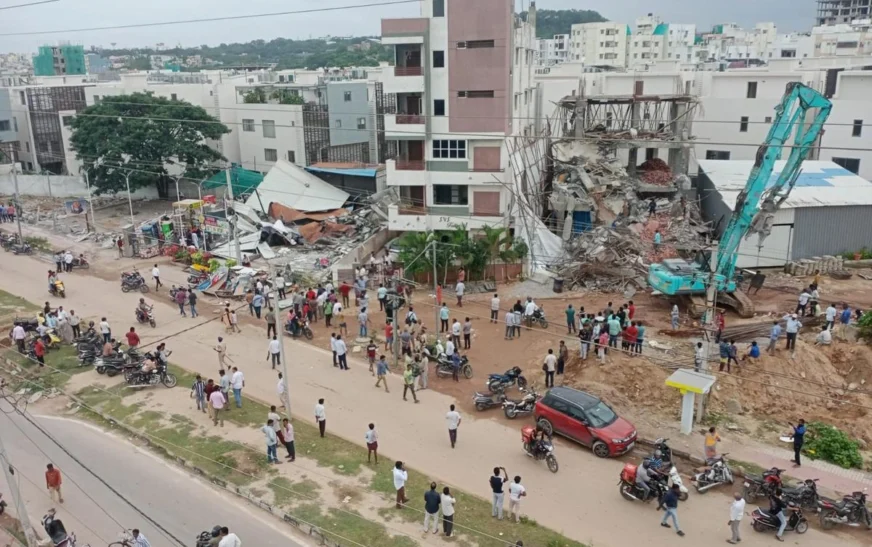
Illegal and unplanned construction on hillsides and floodplains has altered natural drainage patterns. Encroachments along rivers and wetlands have reduced the landscape’s capacity to absorb excess water. Quarrying in environmentally fragile regions has raised concerns about slope stability in some areas. Deforestation and soil degradation have weakened natural barriers that once helped protect communities.
Individually, these may appear to be local issues.
Collectively, they reshape an entire ecosystem.
Nature eventually responds.
The Reports Already Exist
Kerala does not suffer from a lack of expert knowledge.
Over the years, several committees, scientific institutions and environmental studies have documented the state’s ecological vulnerabilities and recommended measures to reduce disaster risks. Reports have highlighted concerns relating to land use, environmental protection, watershed management, quarrying, hill development and construction practices.
The challenge today is no longer identifying the problems.
The challenge is implementing solutions.
Every report that remains on a shelf represents an opportunity delayed.
From Identification to Execution
Disaster management cannot remain reactive.
Rescue operations save lives, but prevention saves generations.
Kerala needs a coordinated, time-bound implementation framework that brings together experts in geology, hydrology, ecology, engineering, urban planning, disaster management and local governance.
Such a mechanism should not merely produce another report.
It should produce measurable outcomes.
Among the priorities could be:
- Mapping vulnerable landslide and flood-prone zones with periodic updates.
- Reviewing illegal constructions in ecologically sensitive regions.
- Strengthening regulation and monitoring of quarrying activities.
- Restoring rivers, wetlands and natural drainage channels.
- Expanding watershed management and afforestation programmes.
- Improving early-warning systems through real-time monitoring.
- Developing district-level resilience plans with defined timelines and public reporting.
Most importantly, recommendations should move beyond consultation to implementation.
Accountability Requires Timelines
Every major infrastructure project operates with deadlines.
Environmental protection deserves the same discipline.
A dedicated state-level task force, supported by independent scientific experts and local administrations, could establish clear targets over one, three and five years, with periodic public progress reports.
Citizens deserve to know not only what has been identified but also what has been achieved.
Development and Conservation Are Not Opposites
Kerala’s aspiration for economic growth is legitimate.
Roads, housing, tourism and infrastructure are essential to development.
But development cannot come at the cost of ecological stability.
When rivers lose their floodplains, hills lose their vegetation and wetlands lose their capacity to absorb water, nature eventually reclaims its space.
The economic cost of repeated disasters often exceeds the cost of preventive planning.
Environmental stewardship is therefore not an obstacle to development—it is an investment in sustainable development.
Why only the government?
Governments alone cannot carry this responsibility.
Local bodies, developers, industries, environmental experts, academic institutions and citizens all have a role to play.
Responsible construction practices, scientific planning, stronger environmental compliance and greater public awareness must become part of Kerala’s development model.
Protecting the environment cannot remain the responsibility of a few activists.
It must become a collective civic ethic.
The Time to Act Is Now
Every flood leaves behind stories of courage.
But it also leaves behind questions that become harder to ignore with each passing year.
Kerala has the scientific expertise.
It has experienced institutions.
It has documented recommendations.
What it now requires is sustained execution, measurable accountability and the collective resolve to act before the next monsoon arrives.
Nature has delivered its warning more than once.
The question is no longer whether Kerala understands the message.
The question is whether it is prepared to respond before the next warning becomes another tragedy.