
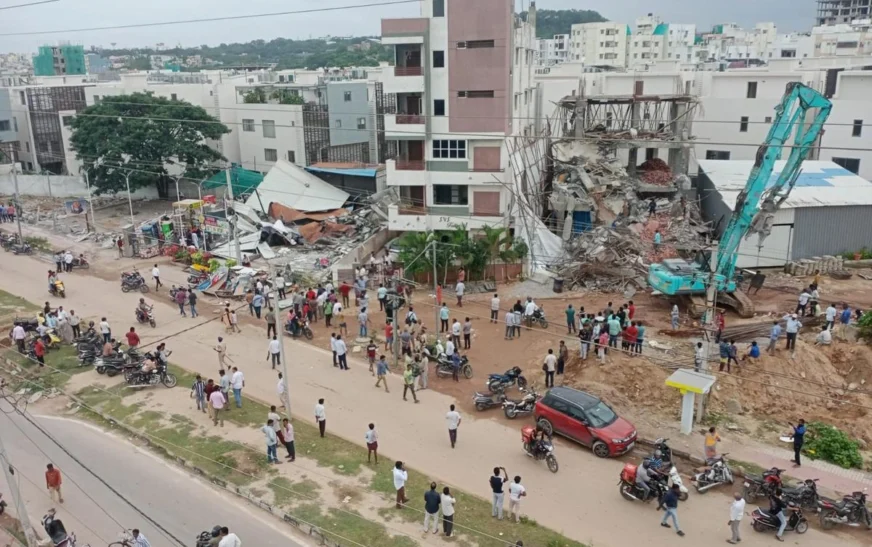
The agency changing the conversation on urban governance
For decades, Hyderabad has stood as one of India’s fastest-growing metropolitan cities. Alongside its remarkable expansion came an equally serious challenge—illegal encroachments on lakes, government land, parks, stormwater drains and public spaces. As the city expanded, its natural ecosystems and civic infrastructure came under increasing pressure.
The establishment of the Hyderabad Disaster Response and Asset Protection Agency (HYDRAA) marked a decisive shift in Telangana’s approach to urban governance. Formed in 2024 under the leadership of Chief Minister A. Revanth Reddy, the agency represents an attempt to restore public assets, strengthen disaster preparedness and ensure that Hyderabad’s future is built on planned, sustainable growth rather than unchecked expansion.
A Vision Beyond Demolitions
For many, HYDRAA is synonymous with demolition drives. Yet its mandate extends much further.
The agency was created to protect government land, lakes, parks, playgrounds, roads, stormwater drains and other public assets while also improving Hyderabad’s disaster response capabilities. Rather than focusing only on removing illegal structures, HYDRAA seeks to restore urban systems that are essential for the city’s long-term sustainability.
Reclaiming What Belongs to the Public
One of HYDRAA’s most visible achievements has been the recovery of encroached public land.
Across Hyderabad and its surrounding urban region, the agency has reclaimed government land, protected parks and open spaces, restored lakes and acted against illegal occupations that had accumulated over many years. In several instances, valuable public property worth hundreds of crores of rupees has been brought back under government control for public use.
Every acre reclaimed represents more than land. It represents parks for children, lakes that reduce flooding, roads that improve mobility and public spaces that belong to every citizen.
Citizens Are Knocking on HYDRAA’s Door
Perhaps one of the strongest indicators of public confidence has been the growing number of citizens approaching HYDRAA with complaints.
Residents who had struggled for years with illegal encroachments, blocked drainage channels, occupied parks and disputed public land increasingly see the agency as a platform through which their grievances may finally receive attention. The agency has also established dedicated complaint mechanisms and helplines for reporting encroachments and protecting public assets.
The long queues of citizens seeking intervention reflect a broader expectation—that public institutions can actively safeguard common property.
Leadership on the Ground
Much of HYDRAA’s operational identity has become associated with its Commissioner, IPS officer A. V. Ranganath.
Known for personally inspecting sites and leading enforcement drives, Ranganath has emerged as the public face of the agency’s asset protection initiatives. His work has attracted both praise and criticism, reflecting the complexities of implementing large-scale urban reforms in a rapidly expanding city.
The Chief Minister’s Urban Vision
Chief Minister A. Revanth Reddy has consistently described HYDRAA as one of the state’s major governance reforms and has publicly defended its mission to protect lakes, parks, nalas and government land from encroachment. He has reiterated that the agency’s work will continue and has emphasised that reclaiming public assets is essential for Hyderabad’s future development.
For the state government, the objective extends beyond enforcement. It is about creating a city where development is supported by environmental protection, planned infrastructure and accountable governance.
A Difficult but Necessary Conversation
Urban reforms of this scale are rarely free from debate.
HYDRAA’s actions have prompted legal challenges and public discussion on issues such as due process, rehabilitation and administrative procedures. These debates are part of the democratic process and underline the importance of ensuring that enforcement remains transparent, lawful and fair.
At the same time, the larger question remains: can a modern city continue to thrive if its lakes disappear, drainage systems are blocked and public land is steadily consumed by illegal encroachments?
Building the Hyderabad of Tomorrow
Cities are remembered not only for their skylines but also for how they protect the resources that sustain urban life.
Roads can be widened. Buildings can be rebuilt. But lakes, wetlands and ecological systems, once lost, are far more difficult to restore.
HYDRAA represents an effort to reverse years of unchecked encroachment while reaffirming a simple principle—that public land belongs to the public. Whether measured in reclaimed lakes, protected parks or recovered government property, its work is shaping an important conversation about the future of Hyderabad.
As Hyderabad continues to grow into a global city, the challenge will not simply be building more—but ensuring that what already belongs to its people is preserved for generations to come.