
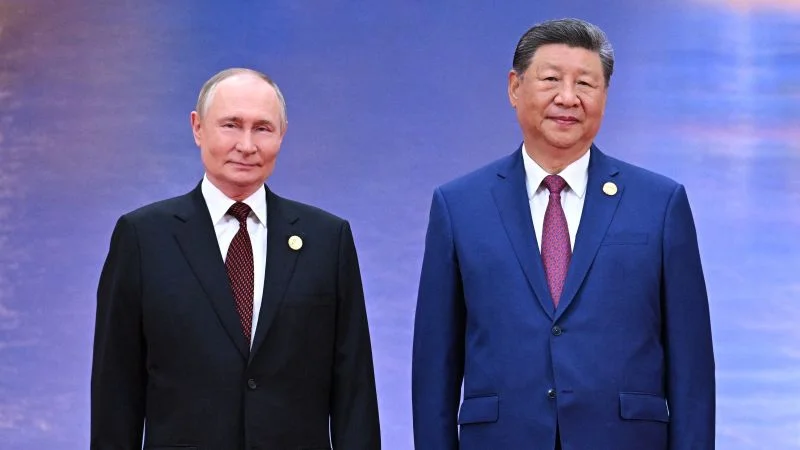
Russian President Vladimir Putin and Chinese President Xi Jinping are set to meet in Bishkek, Kyrgyzstan, during the Shanghai Cooperation Organisation (SCO) summit, bringing together more than a dozen leaders at a time of growing geopolitical tensions. The meeting is expected to focus attention on Russia-China relations, regional security, economic cooperation and the wider shift towards a more multipolar global order.
The SCO has traditionally concentrated on regional security and economic cooperation, but its political significance has expanded. Putin and Xi have increasingly used the organisation as a platform to promote their vision of a world in which global influence is not dominated by a single power. Although the SCO officially maintains that it is not directed against other states, its recent summits have increasingly featured criticism of Western policies and calls for a different international balance.
The Putin-Xi meeting is particularly important because both countries are facing pressure from the United States and its allies, although their strategic interests are not identical. Russia remains heavily focused on the Ukraine conflict and its confrontation with the West, while China is managing its own economic and geopolitical competition with Washington.
For Moscow, closer ties with Beijing provide an important economic and diplomatic lifeline. China has become a major destination for Russian energy exports and an increasingly important trading partner. For Beijing, Russia provides energy resources, strategic depth and a partner that shares concerns about what both governments describe as excessive US influence in global affairs.
However, the relationship should not be interpreted as a formal military alliance. The SCO itself is not equivalent to NATO, and its members have significant differences. India and China, for example, remain strategic competitors despite participating in the same organisation. Turkey is also attending the summit despite not being an SCO member. Iran, meanwhile, has developed close military ties with Russia and important energy relations with China.
This makes the SCO an unusual diplomatic platform. Countries with competing interests can still cooperate on selected issues while maintaining their own foreign-policy priorities.
The presence of Indian Prime Minister Narendra Modi adds another important dimension. India maintains strong ties with Russia while simultaneously deepening strategic cooperation with the United States and other Western countries. New Delhi’s participation therefore demonstrates the increasingly complex nature of global diplomacy, where countries are avoiding rigid alignment with one major power bloc.
The summit also comes amid major tensions in West Asia. Iranian President Masoud Pezeshkian is expected to attend and hold discussions with Putin. Iran’s relationship with Russia and China has become increasingly important as Tehran faces pressure from Washington.
From an analytical perspective, the most important outcome may not be a single agreement. The significance lies in who is sitting around the same table and what that gathering represents. Russia, China, India, Iran and other Eurasian powers increasingly have platforms where they can coordinate without relying on Western institutions.
Yet the SCO’s future influence will depend on whether it can move beyond political declarations. Its members have different economic systems, security priorities and relationships with the United States and Europe. Turning those differences into a coherent long-term strategy will be difficult.
For Russia, the summit offers an opportunity to demonstrate that Moscow is not diplomatically isolated. For China, it reinforces Beijing’s growing influence across Eurasia. For India, the gathering provides another platform to protect its strategic autonomy and engage simultaneously with competing global powers.
The Putin-Xi meeting therefore matters beyond the Russia-China relationship. It is part of a wider transformation in international politics, where multiple centres of power are attempting to shape a more multipolar world. Whether that emerging order becomes more cooperative or more divided will depend on how these relationships evolve.