
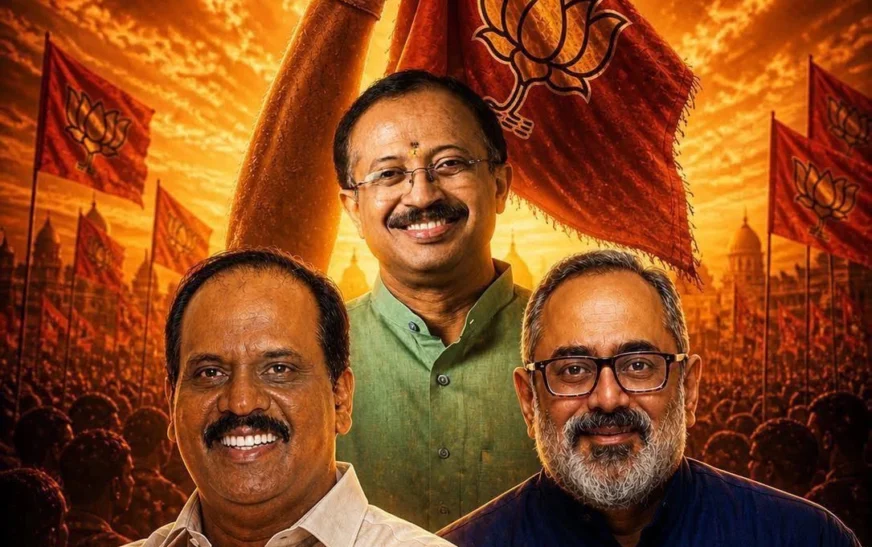
Thiruvananthapuram, Kerala — In a dramatic shift that will reshape Kerala’s political landscape, the Bharatiya Janata Party (BJP) has scripted a historic breakthrough in the 2026 Kerala Legislative Assembly elections. The victories of V. Muraleedharan in Kazhakkoottam, Rajeev Chandrasekhar in Nemom, and B.B. Gopakumar in Chathannoor mark not just tactical wins, but a loud, statewide signal that the BJP’s footprint in the “Left‑fortress” of Kerala has deepened beyond symbolism. Behind this triumph lie not clever strategies, but an unyielding grassroots battle—one fought booth‑by‑booth, door‑to‑door, rain or shine.
Kazhakkoottam: Muraleedharan’s Fortress Falls
The Kazhakkoottam constituency, once a stronghold of CPI(M) firebrand Kadakampally Surendran, was the BJP’s highest‑visibility target in the state. For years, the Left had turned Kazhakkoottam into a symbol of its dominance over the Thiruvananthapuram‑Kazhakkoottam‑Nemom urban belt. But in 2026, Union minister V. Muraleedharan led the BJP’s charge, turning the seat into a high‑profile contest that drew national attention.
Muraleedharan, a former BJP Kerala state chief, did not rely on flash‑crowd rallies alone. His campaign combined a systematic booth‑level mobilisation, micro‑targeting of youth and middle‑class voters, and a narrative of “central‑development‑linked” growth for the fast‑urbanising corridor. The result: a decisive victory that shattered the myth that the BJP could not capture Left‑heartland urban constituencies in Thiruvananthapuram.
Nemom: Chandrasekhar’s Redemption and Gateway Narrative
Nemom, the BJP’s only Assembly seat in Kerala during the 2016 election, has long been the party’s “gateway” narrative for the state. In 2026, that symbolism became a reality as Rajeev Chandrasekhar, BJP’s national president and former Rajya Sabha member, personally contested the seat against CPI(M) education and labour minister V. Sivankutty.
The contest was nail‑biting: early rounds showed Sivankutty ahead, but the BJP’s ground‑network pushed Chandrasekhar into the lead by the later stages. Chandrasekhar ultimately won with a margin of about 3,500–3,600 votes, defeating a sitting minister and one of the Left’s most prominent faces. This victory was read as proof that the BJP’s blend of national‑branding and local‑organisation had matured in Kerala, and that the “Nemom‑gateway” story was no longer aspirational but operational.
Chathannoor: Gopakumar’s Thunder‑bolt Upset
In Chathannoor, a traditionally Communist‑held seat in Kollam district, B.B. Gopakumar executed one of the most stunning upsets of the election. The BJP’s candidate, running under the NDA umbrella, forced the veteran CPI incumbent R. Rajendran into a runoff‑style‑style finish, with votes swinging back and forth in the final rounds.
Gopakumar, a relatively low‑profile face earlier, emerged as the hero of the BJP’s southern‑Kerala expansion project. His win marked the first time the BJP/NDA opened an account in the Chathannoor belt and gave the party a foothold in the Kollam‑Kazhakkoottam‑Nemom corridor, which is fast emerging as the BJP’s core “Southern‑Kerala” base.
The Real Story: BJP’s Booth‑Level Storm Troops
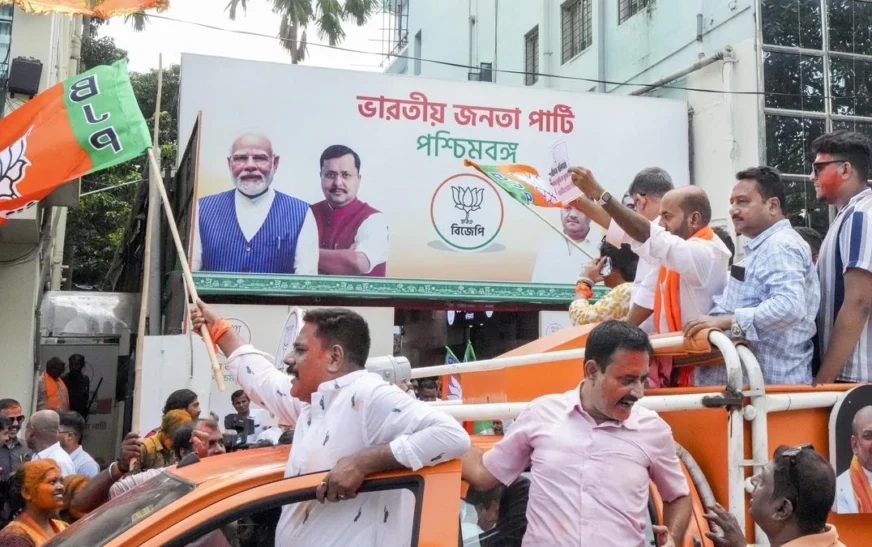
While the media spotlight hovers on the three “lion‑cub” leaders—Muraleedharan, Chandrasekhar, and Gopakumar—the real drivers of the BJP’s 2026 Kerala surge were the party’s cadre and booth‑level workers. In the months leading to the polls, BJP volunteers blanketed Kazhakkoottam, Nemom, and Chathannoor with posters, digital campaigns, and door‑to‑door outreach, tirelessly countering the narrative that the BJP had “no base” in the state.
When the counting began, the BJP shot up to leads in around four to five seats across the state, with Nemom, Kazhakkoottam, and Chathannoor forming the core of that early‑tally breakthrough. Even as the Congress‑led UDF swept to power in the state, these three seats gave the BJP the status of a credible third‑force in Kerala, no longer a marginal player but a bloc that can influence alliance equations and future seat‑sharing.
Why These Wins Matter for India’s BJP Narrative
The victories of Muraleedharan in Kazhakkoottam, Chandrasekhar in Nemom, and Gopakumar in Chathannoor go beyond Kerala’s internal politics. They feed directly into Prime Minister Narendra Modi’s “vikasit Bharat” (developed India) narrative, proving that the BJP can now implant itself in states that once seemed culturally and politically impregnable.
For the BJP, Kerala’s 2026 results are a template for the 2031 Assembly elections: a mix of high‑profile, nationally‑recognised leaders anchoring the campaign, combined with relentless local‑level organisation and a focus on the Thiruvananthapuram‑Kollam‑Idukki‑Wayanad belts where the party’s voter‑base is gradually consolidating.
Next Steps: From Symbolic Wins to Legislative Power
The three new BJP‑NDA MLAs—Muraleedharan, Chandrasekhar, and Gopakumar—now carry the weight of representing the party’s first‑sustained breakthrough in Kerala. Their mandate is clear: translate booth‑level energy into floor‑level influence, turn the BJP’s thin‑but‑growing presence into a louder, more assertive voice in the Assembly, and lay the groundwork for the next phase of the saffron‑camp’s southern‑Kerala expansion.
As one senior BJP leader in the state put it: “This is not the end of the BJP’s story in Kerala. It’s the beginning of the second chapter.