
As the RSS marks 100 years, understanding one of India’s most influential socio-cultural organisations.
By the Editorial Desk | Namo Bharat Times
One hundred years is a remarkable milestone for any organisation. For the Rashtriya Swayamsevak Sangh (RSS), which completed a century since its founding in 2025, the occasion has prompted renewed public interest in its history, philosophy, social initiatives, and influence on India’s public life.
Few organisations have generated as much discussion, admiration, criticism, and academic attention as the RSS. To its supporters, it represents discipline, volunteerism, cultural continuity, and nation-building. To its critics, it raises important questions about ideology and its influence in India’s political and social landscape. Regardless of perspective, there is little disagreement that the RSS has become one of the most significant socio-cultural organisations in independent India.
A Beginning in Nagpur
The RSS was founded on 27 September 1925 by Dr. Keshav Baliram Hedgewar in Nagpur.
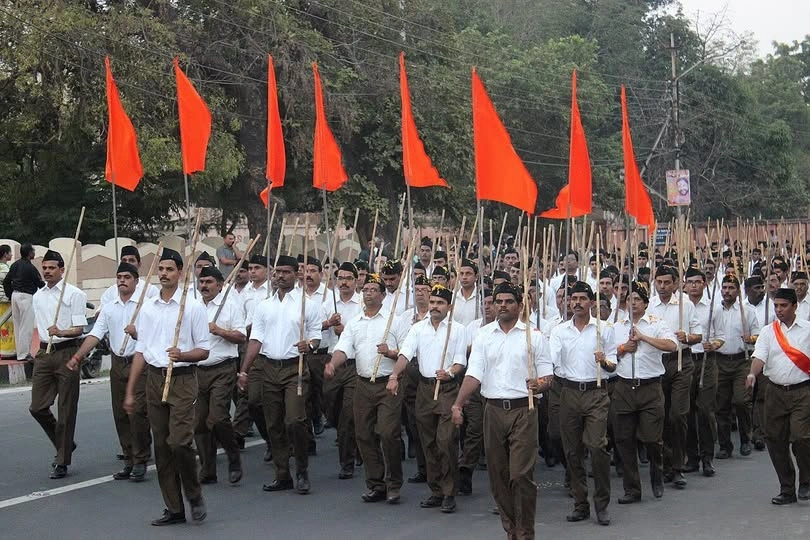
Dr. Hedgewar envisioned an organisation that would focus on building disciplined citizens who would place national service above personal interest. Instead of functioning as a political party, the organisation developed around volunteer participation through its daily neighbourhood gatherings known as shakhas.
These gatherings combine physical exercise, games, discussions, patriotic songs, and community interaction, with the stated objective of nurturing discipline, leadership and civic responsibility.
Volunteerism at the Core
One of the defining characteristics of the RSS has been its emphasis on voluntary service.
Over the decades, RSS volunteers and organisations associated with the wider Sangh network have participated in relief efforts during floods, earthquakes, cyclones and other natural disasters. Educational institutions, healthcare initiatives, blood donation drives, tribal welfare programmes and rural development projects have also become part of the organisation’s public activities.
Supporters often cite this extensive volunteer network as one of the RSS’s greatest contributions to society.
Youth, Discipline and Leadership
The RSS places considerable emphasis on developing leadership qualities among young people.
Its stated approach is that strong societies are built by individuals who possess discipline, integrity, physical fitness and a spirit of public service.
Many people who later entered public administration, education, social work, business and politics have spent part of their formative years participating in RSS activities or institutions associated with its broader network.
Nation Building as a Social Responsibility
According to the RSS, nation-building extends beyond government policy. It begins with responsible citizenship.
The organisation has consistently spoken about civic responsibility, national unity, disaster preparedness, respect for India’s armed forces, and the importance of preserving India’s cultural and civilisational heritage. It has also encouraged community participation in education, environmental conservation and social welfare.
Whether one agrees with every aspect of its philosophy or not, these themes have remained central to its public messaging for decades.
An Organisation That Inspires Debate
The RSS has never existed without public debate.
Supporters describe it as a disciplined volunteer movement committed to national service and social cohesion. Critics have questioned aspects of its ideology, historical positions and relationship with political developments in India.
For historians, sociologists and political scientists, the organisation represents an important subject of study precisely because of its influence on modern India’s social and public life.
Understanding the RSS therefore requires engaging with multiple perspectives rather than relying on a single narrative.
A Century Later
As the RSS reflects on one hundred years of existence, its journey mirrors many of the conversations that have shaped modern India—national identity, citizenship, community service, cultural preservation, public participation and democratic debate.
Whether viewed through the lens of history, sociology or public administration, the organisation continues to occupy an important place in India’s national conversation.
For readers seeking to understand contemporary India, the RSS remains an organisation worthy of study—not because everyone shares the same opinion about it, but because informed understanding is always preferable to assumption.
Five Books to Understand the RSS
1. Bunch of Thoughts — M. S. Golwalkar
A foundational work within the RSS tradition that outlines the ideas and philosophy associated with M. S. Golwalkar, the organisation’s second Sarsanghchalak.
2. The RSS: A View to the Inside — Walter K. Andersen & Shridhar D. Damle
One of the most comprehensive scholarly studies examining the RSS’s organisational structure, evolution and role in Indian society.
3. The Brotherhood in Saffron — Walter K. Andersen & Shridhar D. Damle
A historical account tracing the growth of the RSS and its expanding organisational network over several decades.
4. RSS: Building India Through Seva — Sudhanshu Mittal
This book focuses on the service-oriented initiatives associated with the RSS, including disaster relief, education, healthcare and rural development, from the author’s perspective.
5. RSS and the Making of the Deep Nation — Dhirendra K. Jha