
Pakistan has sought Canada’s diplomatic support for the restoration of the Indus Waters Treaty (IWT), urging Ottawa to help revive the decades-old water-sharing agreement with India. The appeal comes as Islamabad continues its international outreach following India’s decision to keep the treaty in abeyance amid heightened bilateral tensions. However, Canada has not issued any official response to Pakistan’s request so far.
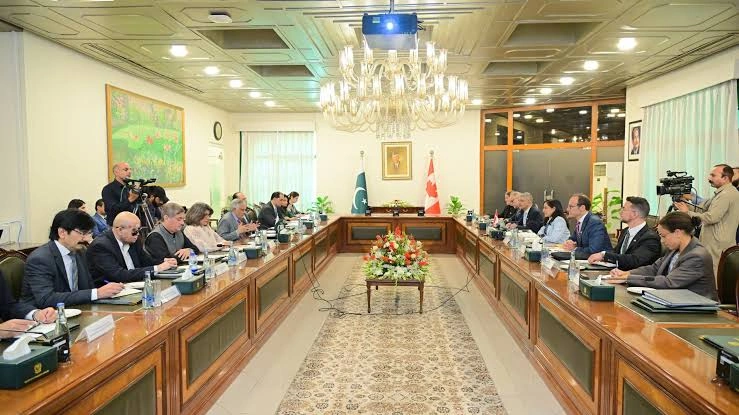
Pakistan’s Deputy Prime Minister and Foreign Minister Ishaq Dar made the appeal during discussions with Canadian officials, calling on Ottawa to encourage India to restore the treaty. Dar described the suspension of the agreement as the “weaponisation of water” and argued that international law and existing bilateral commitments should be respected. He also expressed concern that the prolonged suspension could further destabilise the region.
The Indus Waters Treaty, signed in 1960 with the World Bank as a facilitator, has long been regarded as one of the world’s most enduring water-sharing agreements. It allocates the waters of the eastern rivers to India while granting Pakistan rights over the western rivers, despite decades of political and military tensions between the two neighbours.
India suspended the operational status of the treaty following the Pahalgam terror attack in April 2025, citing persistent cross-border terrorism and changed security circumstances. Since then, New Delhi has maintained that the agreement can no longer function in its existing form and has insisted that Pakistan must take credible and irreversible action against terrorism before any reconsideration of its position.
While Pakistan has repeatedly approached the international community, including the World Bank and other global partners, to seek support for restoring the treaty, India has consistently maintained that the issue remains a bilateral matter. The Indian government has also argued that significant changes in regional security, climate conditions and water management requirements justify a comprehensive renegotiation of the agreement.
Canada has remained publicly silent on Islamabad’s latest appeal. There has been no official statement from Ottawa indicating whether it intends to play any role in facilitating dialogue between India and Pakistan on the issue. Analysts suggest Canada may be reluctant to intervene directly in a dispute involving two sovereign nations without a formal international mandate.
The dispute over the Indus Waters Treaty has become one of the most sensitive issues in India-Pakistan relations. Pakistan considers the treaty vital for its agriculture and water security, while India argues that evolving geopolitical realities and repeated security challenges require a reassessment of the six-decade-old agreement. The differing positions have further widened the diplomatic gap between the two countries.
As diplomatic efforts continue, there is no indication of an immediate breakthrough. With Canada yet to respond and India reiterating that the treaty will remain in abeyance under the current circumstances, the future of the Indus Waters Treaty remains uncertain, adding another layer of complexity to already strained bilateral relations.