
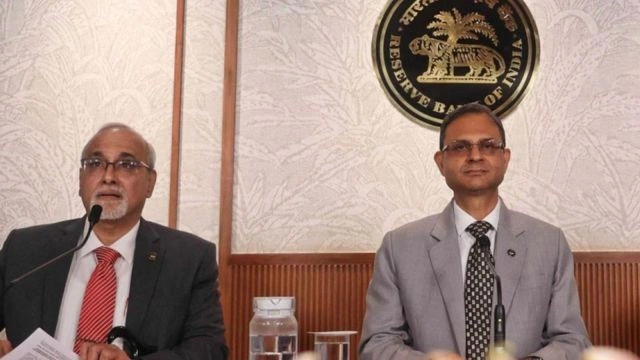
The Reserve Bank of India (RBI) has kept the repo rate unchanged at 5.25%, marking the third consecutive policy meeting without a change in the benchmark lending rate. The decision was announced after the Monetary Policy Committee (MPC) concluded its three-day meeting, reflecting the central bank’s cautious approach amid global uncertainty and domestic inflation risks.
Alongside the rate decision, the RBI raised its GDP growth forecast for FY2026-27 to 6.7% from 6.6% while lowering its inflation forecast to 5%, expressing confidence in India’s economic resilience.
Repo Rate Remains at 5.25%
The six-member Monetary Policy Committee voted to maintain the policy repo rate at 5.25%, keeping the central bank’s policy stance unchanged.
The RBI said the decision balances the need to support economic growth while remaining vigilant about inflationary pressures arising from global geopolitical developments and volatile commodity prices.
Growth Forecast Revised Upwards
Reflecting stronger-than-expected domestic economic activity, the RBI revised its FY27 GDP growth projection upward to 6.7%.
According to Governor Sanjay Malhotra, robust domestic demand, sustained investment activity, and resilience in the services sector have contributed to the improved outlook despite external challenges.
Inflation Projection Lowered
The central bank also reduced its inflation forecast for FY2026-27 to 5%, indicating expectations of easing price pressures compared with earlier estimates.
However, the RBI cautioned that inflation risks remain due to:
- Global crude oil price volatility.
- Geopolitical tensions in West Asia.
- Weather-related risks affecting food prices.
- Uncertainty in international financial markets.
Why the RBI Chose to Hold Rates
The RBI noted that while inflation remains above its medium-term target, it is still within the prescribed tolerance band. Maintaining the current repo rate allows policymakers to assess evolving economic conditions before taking further action.
Governor Malhotra emphasized that future monetary policy decisions will remain data-dependent, with the central bank closely monitoring inflation, growth, and global developments.
Impact on Borrowers and Depositors
Since the repo rate remains unchanged:
- Existing home loan and vehicle loan EMIs linked to external benchmark rates are unlikely to change immediately.
- Banks are expected to maintain current lending and deposit rates unless market conditions shift.
- Businesses and consumers may continue to benefit from stable borrowing costs in the near term.
Outlook for the Economy
The RBI said India’s economy continues to demonstrate resilience despite global headwinds. Strong domestic consumption, public and private investment, and a stable financial system are expected to support growth during the current financial year.
At the same time, the central bank reaffirmed its commitment to keeping inflation under control while ensuring macroeconomic stability. Analysts believe the RBI could consider policy tightening later in the year if inflation accelerates significantly, but for now the emphasis remains on balancing growth with price stability.