
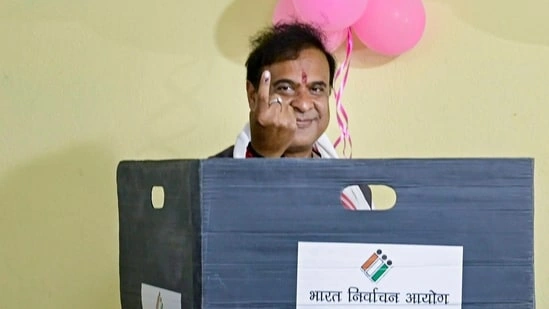
Jalukbari in Assam’s Kamrup Metropolitan district has once again delivered a decisive verdict in favour of Chief Minister Himanta Biswa Sarma, confirming the seat as his personal fortress even as the Congress‑led opposition and BJP’s allies narrowed the gap. The Jalukbari Election Result 2026 shows that the BJP‑led NDA candidate has secured a comfortable win, though not by the record‑shattering margins seen in 2021, underscoring both the durability of Sarma’s brand and the growing political assertiveness of his rivals.
Result and margin in Jalukbari 2026
Himanta Biswa Sarma, contesting from the Bharatiya Janata Party, has retained the Jalukbari seat, extending his streak of consecutive victories from this constituency and reinforcing his image as one of Assam’s most electorally invincible politicians. The final tally indicates that he has comfortably outpaced Congress‑fielded Bidisha Neog, the main challenger, even as the Congress‑Bodoland People’s Front (BPF)‑led opposition bloc managed to raise its vote share compared with the 2021 verdict when Sarma had won by over 1 lakh votes.
The 2021 result—where Sarma polled 1,30,762 votes with a 77.39 per cent vote share and a 1,01,911‑vote margin—had set a high‑bar benchmark, and the 2026 outcome suggests that while the BJP’s dominance in Jalukbari remains intact, it is no longer a landslide‑proof monolith. The Congress‑BPF‑AJP‑led front, along with smaller independents, chipped away at the periphery, turning Jalukbari into a symbol of both incumbency strength and pressure‑from‑below in Assam’s capital belt.
Why Jalukbari matters in Assam politics
Jalukbari is widely seen as Assam’s most high‑profile Assembly seat, not just because it is represented by the Chief Minister but also because it sits at the confluence of urban Guwahati, industrial‑corridor dynamics, and ethnic‑minority electoral calculations. The 2026 campaign in Jalukbari pitted the BJP’s narrative of development, border‑security, and welfare‑schemes against the opposition’s arguments on land‑rights, demographic change, and perceived regional‑neglect, making the seat a microcosm of the broader state‑level T–V‑contour contest.
For the BJP, successfully holding Jalukbari with a strong if not record‑breaking margin validates the party’s strategy of combining central‑centric messaging with hyper‑local‑delivery politics. For the Congress‑BPF‑AJP‑led front, the fact that the margin has shrunk and the BJP’s vote share has moderated is read as evidence that the NDA’s hold on the northeastern capital region is more contestable going forward.
Key campaign issues and voter behaviour
In Jalukbari 2026, the contest centred on three overlapping themes: governance‑performance (roads, infrastructure, public‑health, and law‑and‑order), identity‑and‑demography worries in the greater Guwahati‑Hajo‑Boko‑belt, and the personal‑equation with Himanta Biswa Sarma, who has represented the seat for over two decades. The BJP leaned heavily on the CM’s direct‑contact‑style politics, welfare‑schemes, and security‑narrative, while the opposition focused on perceived marginalisation of indigenous communities and the fear of demographic shift linked to migration and land‑alienation.
The seat recorded a high turnout, consistent with Assam‑wide voting intensity, indicating that even in a relatively safe‑incumbent constituency, voters were keen to register their preferences on both performance and identity. The narrower margin in 2026 suggests that anti‑incumbency, though not enough to dislodge the CM, did nibble at the BJP’s base in pockets where identity‑centric grievances and socio‑economic dissatisfaction overlapped.
Implications for Himanta Biswa Sarma and Assam
The Jalukbari Election Result 2026 cements Himanta Biswa Sarma’s status as Assam’s central political figure while also signalling that his electoral cushion is no longer absolute. For the BJP‑led NDA, retaining the seat with a strong but not overwhelming margin allows the party to project confidence while starting to recalibrate its outreach in the Guwahati‑metropolitan belt, where urban professionals, youth voters, and minority communities are increasingly influential.
For the Congress‑BPF‑AJP‑led opposition, the outcome in Jalukbari sets the template for how to challenge the BJP in the state’s high‑value seats: by combining identity‑focused messaging with improved local‑level organisation and stronger candidate‑profiles. How all sides interpret this “fortress‑that‑held‑but‑narrowed” verdict in Jalukbari will shape seat‑sharing and campaign strategies in the 2031 Assam Assembly elections.